
Guide › Fit check
Is your company a fit for micro1? A two-minute check
Answer a few questions about how your company works and where its records live. You'll get a plain answer on whether micro1's Company Data Partnerships program is likely to fit, and what to do next.
Nothing you enter leaves this page. The check runs in your browser and sends your answers to nobody, me and micro1 included. micro1 makes the real decision after you register.
Your result
Your company looks like a strong fit
On these answers, your company matches what micro1 says it's looking for. The next step is micro1's own application, which takes about 10 minutes.
Your company could fit
Some answers match what micro1 looks for and some are borderline. Registering costs nothing, and micro1's team checks the fit for you. If you'd like a second opinion first, ask me.
micro1's program probably isn't a fit yet
At least one answer falls outside what micro1 publishes about the companies it accepts. That can change as a company grows, so keep the guides to hand.
Why
- micro1 looks for 30+ employees. Under that, the program doesn't apply.
- micro1 asks for records that are mostly in English.
- micro1's program for closed companies lists the US, UK, Canada, India, Australia, Singapore, Ireland, the Netherlands, Germany and France.
- Your headcount is in the range micro1 describes.
- Your headcount is well over micro1's minimum, which means more varied records.
- Desk work leaves a written trail of decisions, which is what frontier AI labs pay for.
- Part of your team works at a desk, so some decisions are written down.
- Mostly hands-on work leaves fewer written records of how decisions get made.
- Your records sit in several everyday tools, which gives micro1 more to work with.
- Records kept mainly in email or one system give micro1 less to work with.
- Three or more years of records adds depth.
- Under a year of records is thin.
- Under two years of trading means a short history.
- Five or more years of trading means a long track record.
- Records partly in another language may lower the price or narrow what micro1 takes.
- Nobody can reach the old systems, so there may be nothing left to license.
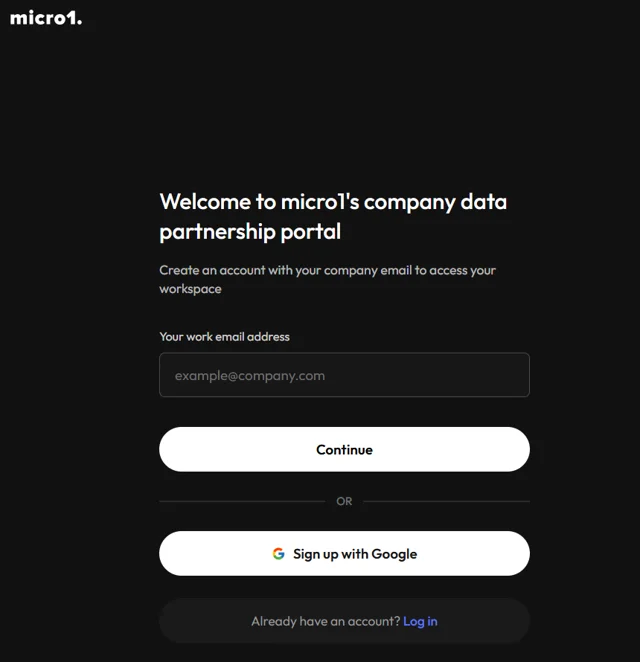 micro1 will ask for your work email. An offer follows if your company fits.
Ask me first
Selling, restructuring or raising money
A data license can sit alongside a sale or a refinancing, and buyers may ask about it in due diligence. If the company is under financial pressure, involve your accountant or adviser before you sign anything. A license agreed at a fair price, with the reasons written down, is easier to defend if anyone questions it later.
Your data as an intangible asset · Raising money without equity · Paying an HMRC tax bill (UK)
Deal with the data before the company closes
While the company still exists, its directors can sign a license. Once a UK company is struck off, its remaining assets pass to the Crown, and US dissolution brings its own limits.
Planning to close your company · Keeping records after closing
Your company has already closed
micro1 runs a separate program for companies that are no longer operating. It lists 30+ employees and companies from the US, UK, Canada, India, Australia, Singapore, Ireland, the Netherlands, Germany and France.
The liquidator or administrator controls the company's assets, so the decision is theirs. Send them this page and the closed-company guide.
The assignee controls the company's assets, so the decision is theirs. The ABC guide explains how that works.
Start by finding out who can still sign for the company. The closed-company guide explains who that usually is.
Company already closed · US: an ABC · Keeping records after closing
Some of your records need extra care
Health records, privileged material and restrictive client contracts don't rule a company out. They usually mean leaving those records out of the license, or agreeing extra steps before anything is shared.
Legal checklist · The privacy questions to ask
Run a US medical practice? Mercor has a program that licenses de-identified patient records. Who qualifies and how to apply
Your team uses Slack or Teams
Chat history is often the most valuable part, and the part with the most rules: staff privacy, and what your software's terms allow you to export.
How the check works
The questions follow what micro1 publishes about the companies it wants. It asks for 30+ employees, established ways of working, records kept in everyday business software, and material that's mostly in English. micro1 Data Partnerships page (micro1.ai/data-partnerships), checked Oct 23, 2026
Headcount and language are hard limits. For a company that has closed, so is the country, because micro1's program for closed companies names the countries it accepts. micro1 referral partner portal, Opportunities (refer.micro1.ai/opportunities), checked Nov 8, 2026
The other answers add up to the result. Desk work counts for more than hands-on work, records spread across chat, documents, CRM and ticket systems count for more than email alone, and longer histories count for more.
The check can't see your data, so it can't put a price on it. Use it to decide whether 10 minutes on micro1's application is time well spent. What company data is worth covers the published figures.
More guides
- Why AI companies pay for dataWhat they're buying, and why everyday work is valuable
- What your data is worthPublished figures and what sets the price
- How names are protectedDe-identification, and what to ask before you sign
- Dark dataThe unused records frontier AI labs pay for
- Paid for your AI agentsHow your agents' work records can earn money
- Is micro1 a scam?The evidence it's real, and six signs of a fake offer
- Is micro1 legit?micro1's company program reviewed, concerns included
- Trusting a referral partnerHow referrers are paid, and signs of a fake one
- SimpleClosure or micro1?Two ways to license company data, compared
- For DPOs: IG pack (UK)Free DPIA and assessment templates
- Legal checklistWhat could stop a deal, and what to exclude
- Staff emails and SlackLicensing staff messages: the rules and what to leave out
- Your software's termsWhat Slack, Microsoft 365 and Google let you export
- Pitching it internally (UK)Free board deck, briefing note and answers
- Pseudonymisation vs anonymisationWhen de-identified data is still personal data
- Raising money without equityHow data licensing compares with grants and loans
- UK companiesWhat a UK company needs before licensing to a US company
- UK companies: US taxWithholding, the treaty, Form W-8BEN-E and VAT
- Paying an HMRC tax billHow Time to Pay works, and where licensing fits (UK)
- Selling your businessYour data as an intangible asset, and due diligence
- Planning to close your companyDeal with the data before you strike off or dissolve
- Company already closedWho qualifies, and who can still sign
- Keeping records after closingHow long to keep them, and who can license them
- US: an ABCWho controls the data in an assignment for the benefit of creditors

About the author
Sean Key has been a freelance consultant for 22 years, mainly delivering data and digital projects into the NHS. He runs Applied Clinical Judgement, which connects professionals with AI training work, and helps established companies weigh up micro1's Company Data Partnerships program.
He isn't a lawyer and isn't employed by micro1. If your company signs up through his introduction, micro1 may pay him a referral fee at no cost to you.
Sean Key on LinkedIn (opens in a new tab) · Book a call (opens in a new tab)