 The Workflow Dividend
Guide › How it works
Why AI companies will pay for your company's everyday data
Most owners have never thought of their inboxes and to-do lists as something anyone would pay for. In 2026 that changed. This page explains why, without the jargon.
What's changed
- AI is now learning how skilled people do their work: handling a claim, chasing an invoice, scoping a project.
- To learn real work, it needs real examples. Those live inside companies, and the public internet has almost none.
- So AI companies, and the data firms that supply them, such as micro1, now pay to license de-identified business data.
- You grant a license. You keep your company and your data.
AI is learning how people do real work
You've probably used an AI chatbot. You type a question and it writes an answer. Those systems learned language by reading enormous amounts of public text: websites, books, forums.
The next generation is meant to help with real work. The industry calls these systems agents. An agent can open your project tracker, read the relevant emails, update the customer record and draft a reply, one step after another. It learns those steps from people who already do the job well.
Public text can't teach that. It's full of finished answers and almost never shows the messy middle: the back-and-forth, the judgment calls, the "we normally do X, but for this client we do Y."
How AI models learn a job
Picture a new hire. You can hand them the manual on day one, but they learn by working through real cases. What came in? What did the team discuss, what did they decide, and how did it turn out?
AI models are now trained in much the same way. They're given a practice version of a real job and learn by trial and feedback. micro1 says each practice job needs three things:
Background
The Slack threads, emails and documents that explain why a task is being done.
Tools
The software people actually use, such as a CRM, an email client or a project tracker, so the AI learns to work inside them.
A task and a way to check it
A real objective, plus a way to tell whether the AI got it right. Often that's an experienced person's feedback.
Source: micro1's description of how it builds training environments, in its June 2026 webinar, below.
Why connected data is worth more than documents
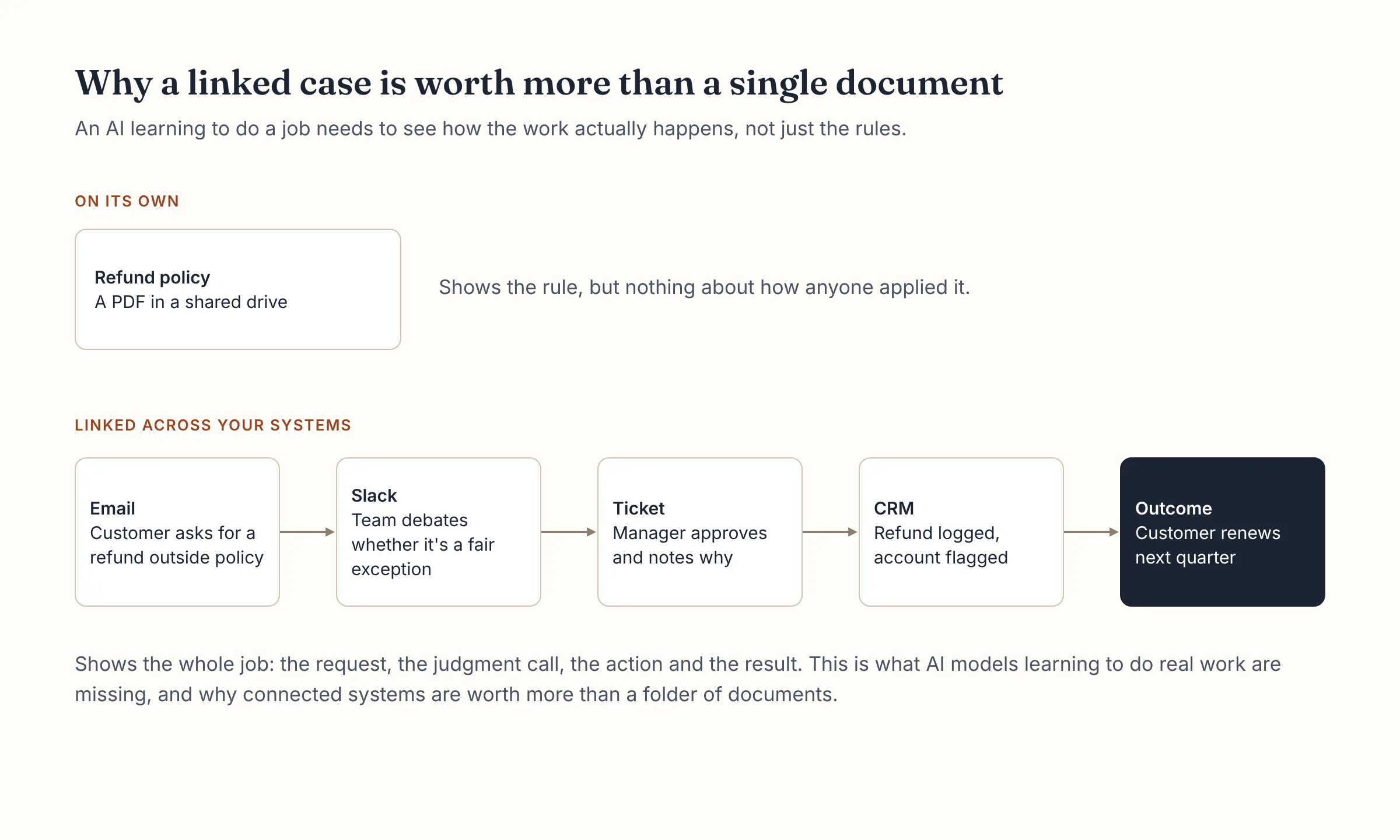
A single policy document gives an AI the rule. The chain of events across your systems shows how the rule was actually applied, and that chain is what buyers want.
Text version of this diagram
On its own: a refund policy, saved as a PDF in a shared drive. It shows the rule, but nothing about how anyone applied it.
Linked across your systems:
- Email: a customer asks for a refund outside policy.
- Slack: the team debates whether it's a fair exception.
- Ticket: a manager approves it and notes why.
- CRM: the refund is logged and the account flagged.
- Outcome: the customer renews next quarter.
The linked version shows the whole job: the request, the judgment call, the action and the result. That's what AI models learning to do real work are missing.
The limits of computer-generated training data
AI companies do generate their own practice data. It comes out clean and logical, a bit like a flight simulator: good for the basics, short on real-world noise. Real work is fragmented. People reply out of order, change their minds and work around broken processes, and an AI trained only on tidy examples tends to stumble when it meets them.
Real data is also scarce. Companies have never published their internal email or chat, so there's no large supply to buy from. That scarcity explains the prices.
Who buys the data, and who sits in the middle
The companies that build AI models, often called AI labs, rarely deal with businesses like yours directly. They buy training data from specialist data companies such as micro1.
The data company signs the license with you, pays you, removes personal details and turns your records into training material. It then supplies that material to the labs. Your contract is with the data company, and the lab never sees names or contact details.
A referrer like me sits outside that chain. You apply to the data company through my referral link, and it pays me a fee if you sign. I don't see your data, and the fee doesn't come out of your payment.
Text version of this diagram
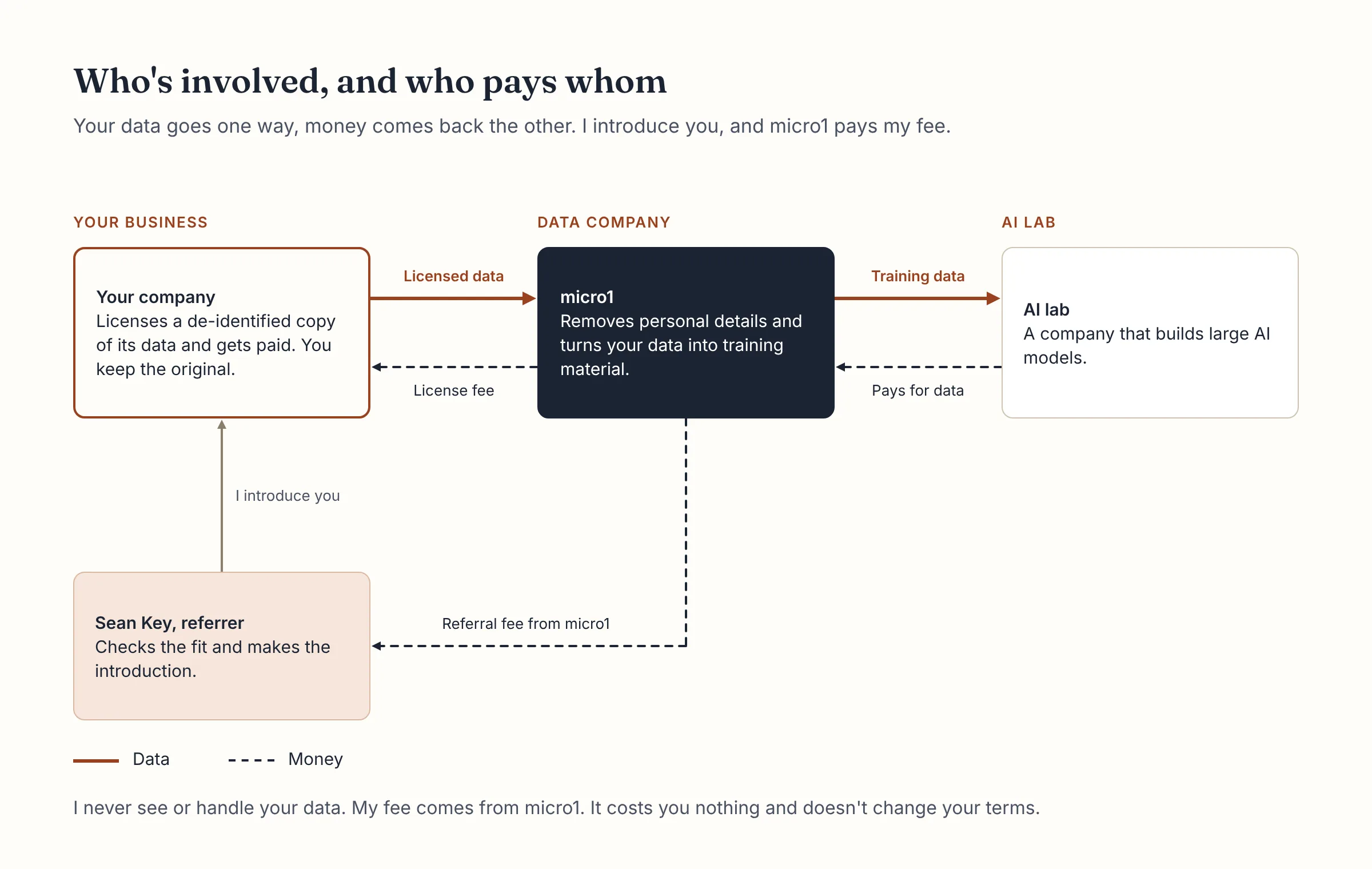
- Your company licenses a de-identified copy of its data to micro1 and is paid a license fee. You keep the original.
- micro1, the data company, removes personal details and turns the data into training material.
- The AI lab, a company that builds large AI models, pays micro1 for that training material.
- Sean Key, the referrer, checks the fit and introduces your company to micro1. micro1 pays him a referral fee.
Data flows from your company to micro1, then to the AI lab. Money flows back the other way. Sean never sees or handles your data, and his fee costs you nothing and doesn't change your terms.
Two ways a company can take part
License a snapshot of past data
A one-time license of a de-identified copy of historical email, chat, documents and CRM records. micro1 calls this a corpus.
Paid ongoing work with AI agents
Your staff set real tasks for AI agents, watch how they do and evaluate the results, and you're paid for each evaluation. Your team learns to use AI along the way. micro1 offers this today.
Which companies have data worth licensing
If you've run an established business for a few years, with email, chat, tickets or written processes, you're probably holding something these companies want. micro1, for example, looks for 30+ employees. Not every business qualifies, and the figures quoted online won't all apply to you, but micro1's application takes about 10 minutes to find out.
Before you go further, you'll want answers to three things: whether the offers are genuine, how customer privacy is protected and what your data could be worth. Each has its own page.
More guides
- Is it a scam?The evidence the program is real, and six warning signs
- micro1 reviewWhat micro1 offers, and the concerns to weigh
- What is your data worth?Published figures and what sets the price
- How names are protectedDe-identification explained, and what to ask before you sign
- If your company has closedWho qualifies, and who can still sign

About the author
Sean Key has been a freelance consultant for 22 years, mainly delivering data and digital projects into the NHS. He runs Applied Clinical Judgement, which connects professionals with AI training work, and helps established companies weigh up micro1's Company Data Partnerships program.
He isn't a lawyer and isn't employed by micro1. If your company signs up through his introduction, micro1 may pay him a referral fee at no cost to you.
Sean Key on LinkedIn (opens in a new tab) · Book a call (opens in a new tab)