For established businesses in the US, UK and Canada · micro1 Company Data Partnerships

Get paid to license your company's data to AI companies

AI companies are teaching software how skilled people do office work, and they need real examples of that work. micro1 will now pay a company like yours to license de-identified copies of your email, chat, documents and CRM records. Partnerships start at $100K and can reach $3M+, depending on the size, quality and uniqueness of your data. You can find out whether your company qualifies in about 10 minutes, through my referral link.

If this sounds like a scam to you, start with the evidence that the program is real.

Register with micro1 (opens in a new tab)micro1 will ask you to enter your work email to register. How micro1's program works
$100K to $3M+micro1's partnership range, depending on the size, quality and uniqueness of your data.
around 60 daysYour usual wait for payment after you start, according to micro1's referral partners.
Sample reviewYou check what will be shared before it's used.

Why AI companies want everyday business data

The newest AI systems learn from how experienced people do their jobs: how a claim gets assessed, an invoice chased, a contract revised. They learn by studying worked examples of that work.

For the last few years, AI models learned from text published on the internet, then from individual documents, checked by tens of thousands of expert reviewers like me. Now AI companies have found that models learn far more from documents in groups, in the context they were used. So the race is on to partner with companies like yours. AI companies will pay large sums to license your day-to-day working documents, email, Slack, Teams and other tools.

Those examples sit inside your company, spread across your inboxes, chat channels, tickets and case files. None of it has ever been published. That's why AI companies will pay for controlled, de-identified access to it. How AI companies use business data

Who's who

How the AI lab, micro1, your business and I fit together

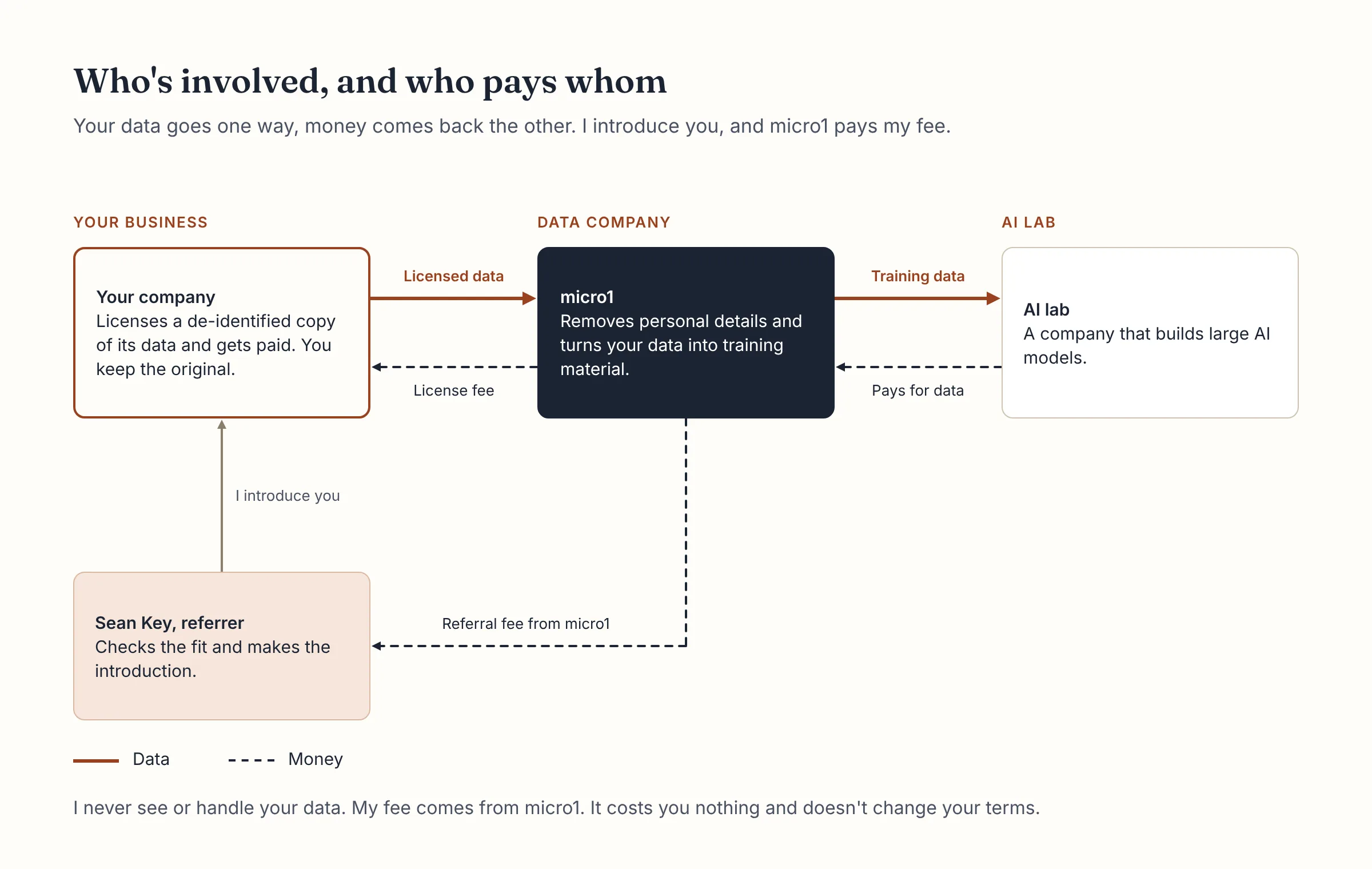
Four parties are involved, and you only deal directly with one of them.

The AI lab

A company that builds large AI models. It's the end user of the training data, and it pays for it. You never deal with the lab, and it never sees your names or contact details.

micro1, the data company

micro1 licenses your data, removes personal details, turns it into training material and supplies it to AI labs. Your contract and your payment are with micro1.

Your business

You license a de-identified copy of your data and agree what's in scope. You keep the original and you approve samples before anything is used.

Me, the referrer

I check whether your company fits and make the introduction. micro1 pays me a referral fee if you sign. I never see or handle your data, and my fee doesn't come out of yours.

Diagram of the four parties. Your company licenses de-identified data to micro1, which turns it into training material for an AI lab. Money flows back the other way: the AI lab pays micro1, and micro1 pays your company a license fee and pays Sean Key a referral fee for the introduction.
Text version of this diagram
  1. Your company licenses a de-identified copy of its data to micro1 and is paid a license fee. You keep the original.
  2. micro1, the data company, removes personal details and turns the data into training material.
  3. The AI lab, a company that builds large AI models, pays micro1 for that training material.
  4. Sean Key, the referrer, checks the fit and introduces your company to micro1. micro1 pays him a referral fee.

Data flows from your company to micro1, then to the AI lab. Money flows back the other way. Sean never sees or handles your data, and his fee costs you nothing and doesn't change your terms.

Is this real?

Recent deals show the race for your data is on

Each figure links to the article or post it came from, so you can check it yourself.

On TV · September 7, 2026 Selling your company's data NBC Bay Area's business show Press:Here on how micro1, led by CEO Ali Ansari, pays companies for their operational data and workflows to train AI. ▶ Watch on NBC Bay Area (opens in a new tab)

$12.5M

micro1's bid for Spirit Airlines' internal emails, Teams messages and records in its bankruptcy auction.

Inc., Oct 2026, checked Oct 23, 2026 (opens in a new tab)

$1B

The amount micro1 has committed over 12 months to licensing company data, with financing from Citi and Hercules Capital.

The Next Web, Oct 2026, checked Oct 23, 2026 (opens in a new tab)

$4B

micro1's valuation after its September 2026 Series B funding round.

Dealroom, Sep 2026, checked Oct 23, 2026 (opens in a new tab)

more than 150

Deals one startup-closing service brokered in a year, selling old chat, email and ticket archives to AI firms for $10K to $100K each.

AI Weekly, citing Business Insider, Oct 2026, checked Oct 24, 2026 (opens in a new tab)

For the concerns as well as the evidence, read my review of micro1's Company Data Partnerships, or the guide to telling a real offer from a fake one.

The program

How micro1's Company Data Partnerships work

This summary uses micro1's own published terms. I don't set these terms and I can't change them.

micro1 · Company Data Partnerships

For your company if your processes are documented, or your team lives in email and chat

Two ways to take part
A one-time license of a de-identified snapshot of your data (micro1 calls this a corpus). Or ongoing work in which your staff set real tasks for AI agents, evaluate the results and get paid per evaluation.
What it pays
Partnerships range from $100K to $3M+, depending on the size, quality and uniqueness of your data. micro1's program page lists tiers of $100k+, $500k+ and $1M+. Workflow work is paid per evaluation; micro1 doesn't publish the rate.
Who fits
30+ employees, a few years of history and English-language data. Your company can be in any industry, mainly in the US, UK or Canada.
How it runs
micro1 describes four stages: apply, evaluation, discovery call, partnership. In practice, you fill in a 10-minute form with rough data sizes and get a price within days. You sign a license agreement, then micro1's engineers handle the export and de-identification. Payment usually arrives around 60 days after you start. A micro1 referral partner explains the process in the video below.
Your controls
You agree the scope first, review samples before anything is used, and keep ownership of your data.
Read the full micro1 review

Source: micro1.ai/data-partnerships, last checked October 23, 2026. Confirm current terms with micro1 before you sign.

Has your company already closed? micro1 also licenses Slack and Teams data from companies that are no longer operating. Who qualifies, and who can still sign

A micro1 referral partner on what owners should know about licensing their data. Video from micro1's YouTube channel. Pressing play loads it from YouTube, where Google's privacy policy applies.

Ready to apply now? Start your company's micro1 application (opens in a new tab). It goes through my referral link, so micro1 knows I introduced you. That costs you nothing.

Does it fit you?

Signs your company's data is a good fit

The best guide is where your know-how actually lives.

Your processes are written down

Procedures, playbooks, case histories and a knowledge base your team actually uses.

Decisions happen in your inbox

Email threads, chat, tickets and CRM notes, where the real calls get made in conversation.

You want ongoing income

micro1's workflow option pays your team per evaluation of AI agents, on top of or instead of a one-time license.

You don't need to be a tech company or have an IT department. Companies that have already taken part include a New York lending business, a Florida pool builder and a 50-person marketing agency. Source: the referral partner interview above.

What happens to your data

The important part: how your data is de-identified and approved

Names, contact details and company names are replaced before the end user, the AI lab, sees anything. micro1 cleans your data for you.

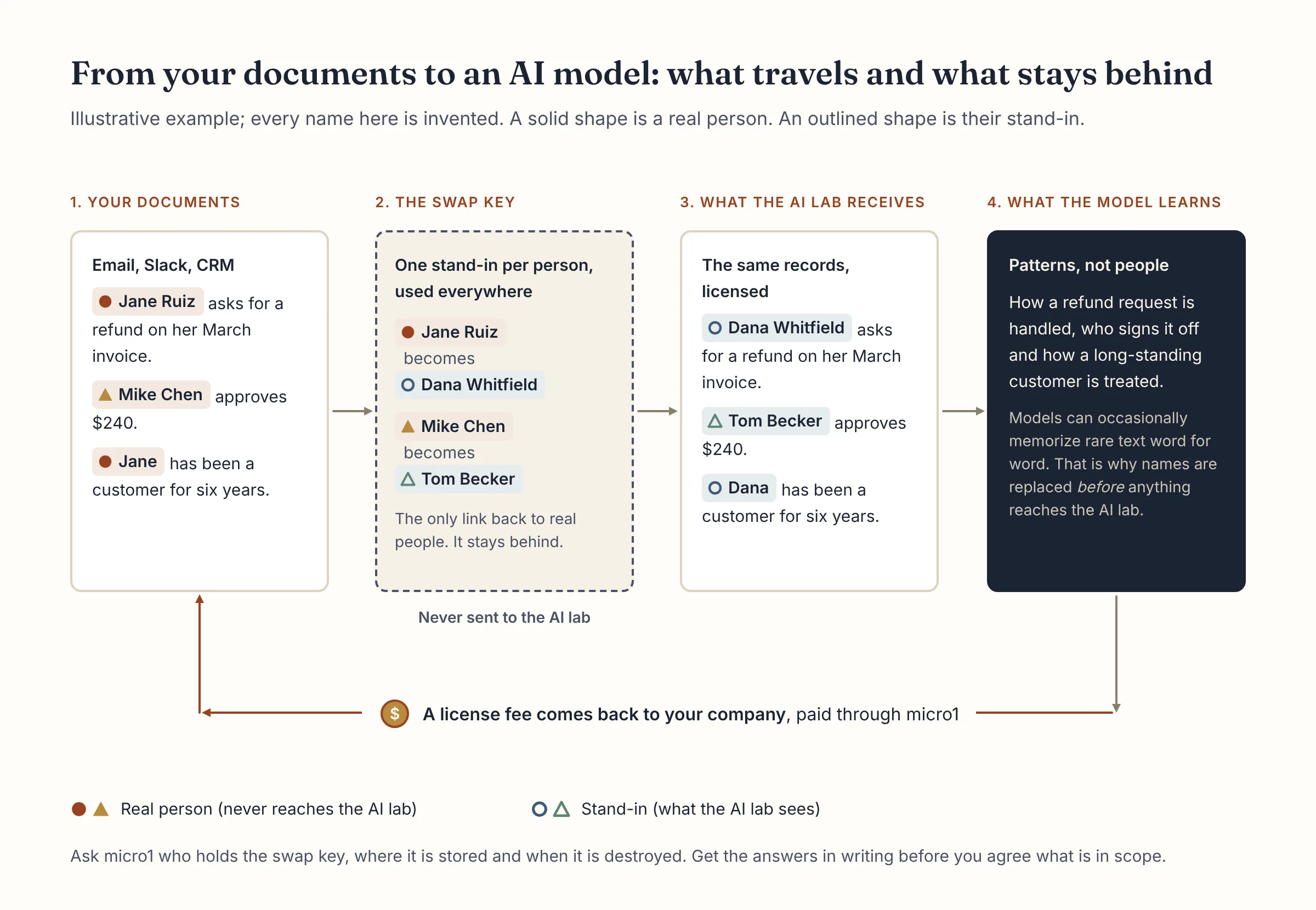
Diagram of the whole process: real names in your documents are swapped for stand-ins using a key that stays behind, the AI lab receives only the stand-in version, the model learns working patterns rather than people, and a license fee comes back to your company through micro1.
Text version of this diagram
  1. Your documents: email, Slack and CRM records mention real people, for example Jane Ruiz asking for a refund and Mike Chen approving it.
  2. The swap key: each real person gets one stand-in, used everywhere. Jane Ruiz becomes Dana Whitfield and Mike Chen becomes Tom Becker. The key is the only link back to real people. It stays behind and is never sent to the AI lab.
  3. What the AI lab receives: the same records with only the stand-in names, so the chain from request to decision still makes sense.
  4. What the model learns: patterns, not people. For example, how a refund request is handled, who signs it off and how a long-standing customer is treated. Models can occasionally memorize rare text word for word, which is why names are replaced before anything reaches the AI lab.
  5. The license fee comes back to your company, paid through micro1.

Every name here is invented. Ask micro1 who holds the swap key, where it is stored and when it is destroyed. Get the answers in writing before you agree what is in scope.

The key that links stand-ins back to real people stays behind. The AI lab gets only the stand-in version, and the license fee comes back to your company.

Read the full guide, including each step your data goes through and the decisions that stay with you

How applying works

How applying through my link works

  1. 01

    Apply through my link

    micro1's form takes about 10 minutes: your company, its systems and rough data sizes. The link tells micro1 I sent you, at no cost to you.

  2. 02

    micro1 checks the fit

    Its team evaluates whether your data fits, then holds a discovery call with you.

  3. 03

    You decide

    Any agreement is between you and micro1. Nothing is shared until you've approved it.

  4. 04

    Ask me if you get stuck

    If you're unsure at any point, send me a message or book a call.

Common concerns

Common concerns about licensing company data

"Are we giving away our IP?"

You grant a license under an agreement you negotiate, and micro1 states that you keep ownership of your data. You agree the scope before anything is shared, so you can leave out trade secrets, client records or whole systems.

"What about privacy law and client confidentiality?"

micro1 de-identifies your data before a buyer sees it. Your sector decides which rules apply: California's privacy law, HIPAA for health data, or professional duties for law firms. The questions to ask before you sign

"What would our customers think?"

Customer names and contact details are removed or replaced before release. Ask about retention, deletion and how free text is scrubbed during the discovery call, and get the answers in writing.

"We don't have time for this."

micro1's referral partners say you can finish a corpus license in two to three weeks, with micro1's engineers doing the export. You'll still need someone with admin access to your systems to give it some time.

From a participating owner

An agency owner on taking part in both micro1 programs

Grant Gooley is Founder & CEO of My Portal Marketing, a 50-person agency. His company licensed a corpus and takes part in workflows. His attorneys reviewed the contracts, and his team kept client data and finances out of scope.

"Just scrubbing is not enough."
He explains that details about a business can be pieced together to identify it, which is why his team left some data out altogether.
Grant Gooley, Founder and CEO of My Portal Marketing, on taking part in micro1's program. Video from micro1's YouTube channel. Pressing play loads it from YouTube, where Google's privacy policy applies.
Sean Key

Who runs this site

I'm Sean Key, a freelance consultant on NHS data projects

I've worked freelance for 22 years, mainly delivering data and digital projects into the UK's National Health Service, where questions about who can see which records come up all the time. I now run Applied Clinical Judgement, which connects professionals with AI training work, and I help companies like yours weigh up micro1's Company Data Partnerships program.

I'm based in England. I write mainly for US owners, because that's where most demand is, but micro1 also takes companies from the UK and Canada.

I'm not employed by micro1. If your company signs up through my introduction, micro1 may pay me a referral fee. That costs you nothing and doesn't change your terms.

Sean Key on LinkedIn (opens in a new tab)

Find out if your company qualifies

Apply through my referral link. micro1's form takes about 10 minutes, and its team checks whether your data fits. There's no cost and no obligation.

Register with micro1 (opens in a new tab)micro1 will ask you to enter your work email to register.
Still not sure?

Ask me first. I'll tell you plainly whether your company looks like a fit.

Send me a message Book a call (opens in a new tab)