 The Workflow Dividend
Guide › Closed companies
Can a closed company sell its Slack and Teams data?
If your company has closed, its Slack, Teams and email archives may still be worth something. micro1 licenses data from companies that are no longer operating. Before anyone talks about money, you need to know who still has the right to sign, and whether the data can lawfully be kept and shared.
At a glance
- micro1 looks for closed companies that had 30+ employees at their peak and hold substantial Microsoft Teams or Slack data.
- It lists compensation of $100K to $2M+ per company, depending on the data. micro1 referral partner portal, Opportunities (refer.micro1.ai/opportunities), checked Oct 24, 2026
- Who can sign depends on the company's status. In the UK, a dissolved company's assets belong to the Crown, so its former directors can't license anything.
- Privacy law still applies after closure, and some questions get harder: how long the data can be kept, telling former staff and customers, and who handles their requests.
Who micro1 is looking for
micro1 calls this its Defunct Company Data Partnership. It's separate from the main Company Data Partnerships program for operating businesses, and its criteria are different.
- Status: the company is no longer operating.
- Size: 30+ employees at its peak.
- Data: substantial Microsoft Teams or Slack history, in English.
- Where: companies based in the US, UK, Canada, India, Australia, Singapore, Ireland, the Netherlands, Germany and France.
- Industry: any.
Criteria from micro1 referral partner portal, Opportunities (refer.micro1.ai/opportunities), checked Oct 24, 2026. Confirm the current terms with micro1 before you rely on them.
Why a closed company's chat history has value
Years of team chat record how decisions were actually made: who was asked, what was weighed, how problems got solved. AI developers want that context, and an operating company's live systems are harder to license than a closed company's archive.
Closing a company and selling its old data is already a market. Fast Company reported closed startups selling chat and email archives for $10K to $100K each. Fast Company, Apr 2026, checked Oct 23, 2026 (opens in a new tab) SimpleClosure, a company that winds down startups, says its asset marketplace has handled more than 150 deals, and almost half included code or workplace data. AI Weekly, citing Business Insider, Oct 2026, checked Oct 24, 2026 (opens in a new tab)
Who can still sign
A company that has stopped trading isn't always a company that has ended. Its legal status decides who, if anyone, can license its data. This is the UK position; ask a lawyer where you are.
| Status | Who decides | What it means |
|---|---|---|
| Stopped trading, still on the register | The directors | Can usually proceed. If the company can't pay its debts, directors must put creditors' interests first, so take advice. |
| In administration or liquidation | The administrator or liquidator | The insolvency practitioner decides, and remains bound by data protection law. UK regulators have warned that passing on personal data in an insolvency can breach it. |
| Dissolved or struck off | Nobody at the company | Its property passes to the Crown as "bona vacantia" under section 1012 of the Companies Act 2006. Former directors can't license it unless the company is restored to the register first. |
In the US, rules vary by state, and a bankruptcy court can appoint a consumer privacy ombudsman to review a sale of personal data, as happened in Spirit Airlines' bankruptcy. AI Weekly, citing Business Insider, Oct 2026, checked Oct 24, 2026 (opens in a new tab)
The privacy questions after closure
The same de-identification applies as for an operating company: real names replaced with consistent stand-ins before an AI lab sees anything. My de-identification guide explains how it works. Four questions are harder once a company has closed.
Keeping the data
Privacy law says data shouldn't be kept longer than needed. A closed company has little reason left to hold staff chat, and much of it may be past its own retention period. Keeping it only to sell it needs a clear justification.
Telling former staff and customers
They're scattered, but you still need to tell people before their data is reused for a new purpose. Plan how you'll reach them and give them a chance to object.
Handling their requests
With nobody left at the company, the agreement needs to say who handles objections, access requests and complaints afterwards.
Private messages
Teams and Slack hold direct messages as well as project channels. Decide what's in scope, and expect more sensitive content than in documents or CRM records.
This is a general explanation, not legal advice. I'm not a lawyer. Ask your adviser, or the insolvency practitioner, what applies to you.
Applying for a closed company
If you were a founder or director of a closed company, or you're handling a company's insolvency, you can apply through my referral link. Say in the application that the company has closed, and what its status is.
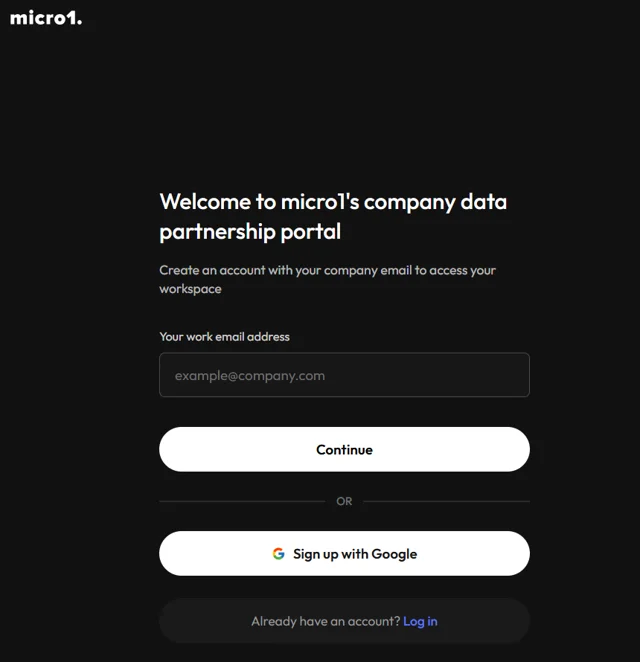 micro1 will ask you to enter your work email to register.
If you're not sure who can sign, use "Still not sure?" below to ask me first. I'm not employed by micro1. If a company signs up through my introduction, micro1 may pay me a referral fee. It costs you nothing and doesn't change your terms.
More guides
- Why AI companies pay for business dataWhat they're buying, and why everyday work is valuable
- Is it a scam?The evidence the program is real, and six warning signs
- micro1 reviewWhat micro1 offers, and the concerns to weigh
- What is your data worth?Published figures and what sets the price
- How names are protectedDe-identification explained, and what to ask before you sign

About the author
Sean Key has been a freelance consultant for 22 years, mainly delivering data and digital projects into the NHS. He runs Applied Clinical Judgement, which connects professionals with AI training work, and helps established companies weigh up micro1's Company Data Partnerships program.
He isn't a lawyer and isn't employed by micro1. If your company signs up through his introduction, micro1 may pay him a referral fee at no cost to you.
Sean Key on LinkedIn (opens in a new tab) · Book a call (opens in a new tab)