 The Workflow Dividend
Guide › AI agents for business
AI agents for business: how they can earn money as well as save it
Most guides to AI agents for business are about saving time. If your company runs agents, or is about to, there's a second side to them. Frontier AI labs, the companies building the most advanced AI models, need records of agents doing real work inside real companies, and micro1 now pays companies for them.
At a glance
- An AI agent's trajectory is the step-by-step record of a task: what it was asked to do, which tools it used, each action it took and how it turned out.
- micro1 says it licenses qualifying trajectories for $1M to $2M a year, with your approval. micro1 Data Partnerships page (micro1.ai/data-partnerships), checked Nov 8, 2026
- It also tests your agents continuously, showing where they fail and supplying training data to fix it. If you don't have agents yet, it offers to build them inside your own systems.
- Separately, your staff can be paid per evaluation to set real tasks for AI agents and judge the results.
Why frontier AI labs want your agents' work
AI agents learn by practicing tasks in simulated workplaces, which the industry calls reinforcement learning (RL) environments. Building those simulations takes examples of real work: how a support ticket actually gets resolved, how an invoice gets checked, how a sales record gets updated across three systems. That kind of example isn't on the public internet. Why AI companies pay for business data explains the wider picture.
An agent working in your company produces exactly that record every time it completes a task. Most companies throw it away or keep it only for debugging.
Four parts of micro1's agent offer
micro1 sets these out on its Data Partnerships page. micro1 Data Partnerships page (micro1.ai/data-partnerships), checked Nov 8, 2026
Agent build-outs (optional)
If you don't run agents yet, micro1 offers to build and deploy them in your real workflows, using your systems and permissions. It puts this in the first two months.
Agent evaluation
Ongoing tests of your agents that show where they fail and why, with targeted training data to fix those failures. The aim is agents that get more reliable over time.
Trajectory purchases
micro1 licenses qualifying records of your agents' work for $1M to $2M a year, recurring from launch. You approve what's shared.
Workflow evaluations by your staff
Your team writes tasks based on their real work, AI agents attempt them in your tools, and staff judge the results. micro1 pays per evaluation but doesn't publish the rate.
What to check before you agree
- What's inside a trajectory. An agent's record can include customer names, email text and figures from your systems. Ask how it's de-identified before anyone else sees it. My de-identification guide lists the questions.
- Permissions and access. Agents act with whatever access you give them. Keep their permissions narrow, log what they do, and agree who can reach your systems during a build-out.
- Who owns what. Agree in writing who owns any agents micro1 builds, the prompts and configuration, and the trajectories themselves.
- Approval and scope. Decide which workflows are in scope and how you approve each batch of trajectories before it's licensed.
- Where the data goes. micro1 says it licenses data only to labs and companies in the US and allied countries. Ask how long raw data is kept and how it's deleted.
- Staff time. Evaluations need people who know the work. Agree how much time is expected, and whether staff are paid for it directly.
Who it suits
It fits established companies with 30+ employees that already use AI agents for repeatable work such as customer support, finance operations, sales administration or IT tickets, or are about to. Work done in English, in the US, UK or Canada, is in most demand.
If your company doesn't use agents, the main program still applies: a one-time license of a de-identified snapshot of your email, chat and documents, worth $100K to $3M+ depending on the data. micro1 creator guidelines (refer.micro1.ai/creators/guidelines), checked Nov 8, 2026 Is micro1 legit? covers both.
Common questions about AI agents and getting paid
What are AI agents for business?
Software that carries out multi-step tasks on its own using your company's tools: answering a support ticket, updating a CRM record, checking an invoice against a purchase order. Unlike a chatbot, an agent takes actions as well as giving answers.
What is an AI agent trajectory?
The complete record of one task: the instruction, each step the agent took, the tools it called, what came back and the final result. Frontier AI labs use trajectories to train and test agents.
Can my company get paid for its AI agents?
Yes. micro1 says it licenses qualifying trajectories from companies' own agents for $1M to $2M a year, with the company's approval. Staff can also be paid per evaluation for testing AI agents on real tasks.
Does micro1 build AI agents for companies?
It offers to, as an optional first step. It builds and deploys agents inside your workflows using your systems and permissions, then tests them and licenses their work records.
Is it safe to let AI agents work in our systems?
It can be, with care. Give agents the narrowest access that does the job, log their actions, and keep a person reviewing anything that can't be undone. Agree the same controls in any contract with an outside builder.
Getting a figure
Registering costs nothing and doesn't commit you. Mention in the application that your company runs AI agents, or wants them.
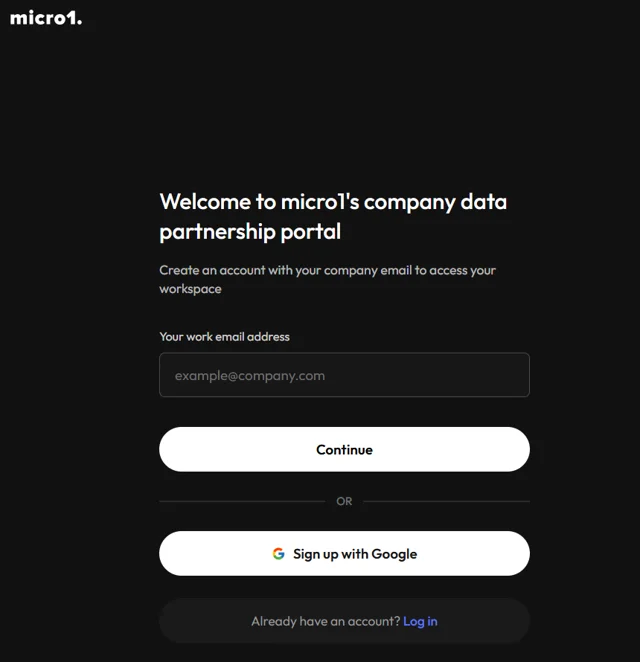 micro1 will ask you to enter your work email to register.
I'm not employed by micro1. If your company signs up through my introduction, micro1 may pay me a referral fee, which costs you nothing and doesn't change your terms.
More guides
- Why AI companies pay for dataWhat they're buying, and why everyday work is valuable
- What your data is worthPublished figures and what sets the price
- How names are protectedDe-identification, and what to ask before you sign
- Dark dataThe unused records frontier AI labs pay for
- Is micro1 a scam?The evidence it's real, and six signs of a fake offer
- Is micro1 legit?micro1's company program reviewed, concerns included
- SimpleClosure or micro1?Two ways to license company data, compared
- For DPOs: IG pack (UK)Free DPIA and assessment templates
- Pseudonymisation vs anonymisationWhen de-identified data is still personal data
- Raising money without equityHow data licensing compares with grants and loans
- Paying an HMRC tax billHow Time to Pay works, and where licensing fits (UK)
- Selling your businessYour data as an intangible asset, and due diligence
- Planning to close your companyDeal with the data before you strike off or dissolve
- Company already closedWho qualifies, and who can still sign
- US: an ABCWho controls the data in an assignment for the benefit of creditors

About the author
Sean Key has been a freelance consultant for 22 years, mainly delivering data and digital projects into the NHS. He runs Applied Clinical Judgement, which connects professionals with AI training work, and helps established companies weigh up micro1's Company Data Partnerships program.
He isn't a lawyer and isn't employed by micro1. If your company signs up through his introduction, micro1 may pay him a referral fee at no cost to you.
Sean Key on LinkedIn (opens in a new tab) · Book a call (opens in a new tab)