 The Workflow Dividend
Guide › Dark data
Dark data: the unused business records frontier AI labs pay for
Every company keeps years of email, chat, documents and tickets that nobody looks at again. The industry calls it dark data, and until recently it was only a storage cost and a privacy risk. Now frontier AI labs, the companies building the most advanced AI models, pay to license de-identified copies of exactly those records.
At a glance
- Gartner describes dark data as information a company collects, processes and stores in the course of business but generally doesn't use for anything else. TechTarget (2021), paraphrasing Gartner, checked Nov 8, 2026 (opens in a new tab)
- In a Splunk survey of business and IT leaders, the average estimate was that 55% of an organization's data is dark. IT Brief, reporting Splunk's State of Dark Data survey, 2019, checked Nov 8, 2026 (opens in a new tab)
- Much of it is the everyday record of how work gets done, which is what AI training data companies such as micro1 license. micro1's partnerships range from $100K to $3M+. micro1 creator guidelines (refer.micro1.ai/creators/guidelines), checked Nov 8, 2026
- Licensing doesn't change your duties under privacy law. Data still has to be de-identified, and personal data shouldn't be kept longer than needed.
What counts as dark data, and what AI labs want
| Dark data | Where it usually sits | Fit for AI training |
|---|---|---|
| Email archives | Google Workspace, Microsoft 365, old mail servers | Strong. Shows how decisions get made and work gets passed on |
| Team chat | Slack, Microsoft Teams | Strong. Real problem-solving, in sequence |
| Process documents | Shared drives, wikis, SOPs, templates | Strong. How the work is meant to be done |
| Support tickets | Zendesk, Freshdesk, Jira Service Management | Strong. A problem, the steps taken and the outcome |
| CRM notes and sales records | Salesforce, HubSpot | Good. The customer lifecycle, step by step |
| Project records | Jira, Asana, Monday | Good. Planning and delivery over time |
| Source code | GitHub, GitLab | Good, though usually through code-specific buyers such as SimpleClosure's marketplace |
| Server logs and sensor data | Monitoring and IoT systems | Usually not what this market is buying |
What makes the records valuable is that they show real people doing real work, connected over time. Why AI companies pay for business data explains why that matters to frontier AI labs.
Three ways to monetize dark data
Use it yourself
Analytics, search tools or internal AI assistants built on your own records. Valuable, but it takes investment and earns nothing directly.
Sell data products
Packaged datasets or insights sold through data marketplaces. Suits companies whose data describes a market, such as prices or transactions.
License it for AI training
A one-time or ongoing license of a de-identified copy. The buyer handles the export and de-identification, and your company keeps the original. What your data is worth sets out the published figures.
Why dark data rarely shows up as an asset
Accounting rules generally don't let a company put records it generated itself on its balance sheet, so their value never appears in the accounts. That's one reason owners overlook them. It matters most when you're selling the business or closing it, because the data can be worth more than you expect.
Before you license dark data
- Find it. List your systems and check retention settings. Some tools delete history automatically, and canceling a subscription can delete years of records.
- Read your privacy notices. They decide what the data can be used for, and who you'd need to tell.
- Decide what's out of scope. Most companies leave out health records, legally privileged material, trade secrets and client confidential files.
- Insist on de-identification. Real names and contact details should be replaced before a frontier AI lab sees anything. My de-identification guide explains how and what to ask.
- Don't keep data just in case. Privacy law says personal data shouldn't be kept longer than needed. If you're not going to license it, your retention policy still applies.
Common questions about dark data
What is dark data?
Information a company collects and stores in the course of business but doesn't use for anything else: old email, chat history, documents, tickets and logs. Gartner popularised the term.
What are examples of dark data?
Email archives, Slack or Teams history, shared-drive documents, support tickets, CRM notes, project records, server logs and sensor data.
How do companies monetize dark data?
Three main ways: using it internally for analytics or AI tools, selling data products through marketplaces, or licensing a de-identified copy to AI training data companies, which pay to help frontier AI labs train their models.
Can you license dark data that contains personal information?
Only with care. The data has to be de-identified, your privacy notices and the law where you operate have to allow the new use, and you may need to tell staff and customers. Take advice if you're unsure.
How much is dark data worth?
It depends on the volume, quality and uniqueness of the records. micro1's partnerships range from $100K to $3M+, and it looks for companies with 30+ employees and several years of records.
Getting a figure
Registering costs nothing and doesn't commit you. micro1 reviews what your company holds and makes a proposal.
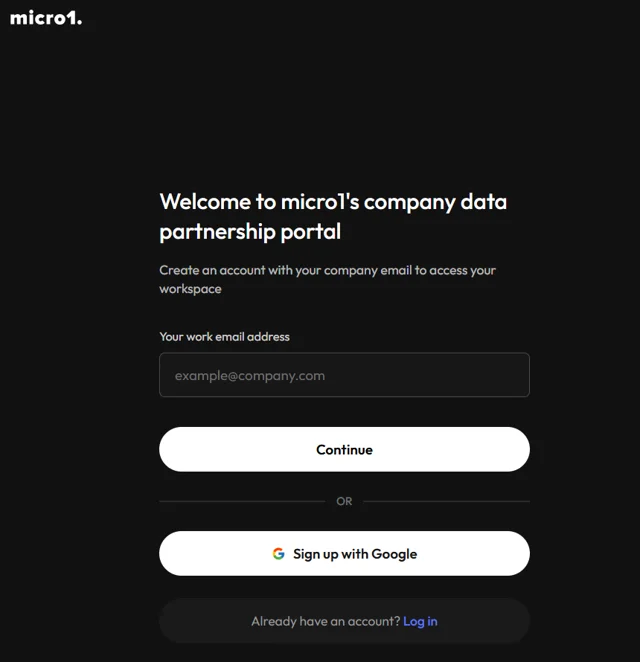 micro1 will ask you to enter your work email to register.
I'm not employed by micro1. If your company signs up through my introduction, micro1 may pay me a referral fee, which costs you nothing and doesn't change your terms.
More guides
- Why AI companies pay for dataWhat they're buying, and why everyday work is valuable
- What your data is worthPublished figures and what sets the price
- How names are protectedDe-identification, and what to ask before you sign
- Paid for your AI agentsHow your agents' work records can earn money
- Is micro1 a scam?The evidence it's real, and six signs of a fake offer
- Is micro1 legit?micro1's company program reviewed, concerns included
- SimpleClosure or micro1?Two ways to license company data, compared
- For DPOs: IG pack (UK)Free DPIA and assessment templates
- Pseudonymisation vs anonymisationWhen de-identified data is still personal data
- Raising money without equityHow data licensing compares with grants and loans
- Paying an HMRC tax billHow Time to Pay works, and where licensing fits (UK)
- Selling your businessYour data as an intangible asset, and due diligence
- Planning to close your companyDeal with the data before you strike off or dissolve
- Company already closedWho qualifies, and who can still sign
- US: an ABCWho controls the data in an assignment for the benefit of creditors

About the author
Sean Key has been a freelance consultant for 22 years, mainly delivering data and digital projects into the NHS. He runs Applied Clinical Judgement, which connects professionals with AI training work, and helps established companies weigh up micro1's Company Data Partnerships program.
He isn't a lawyer and isn't employed by micro1. If your company signs up through his introduction, micro1 may pay him a referral fee at no cost to you.
Sean Key on LinkedIn (opens in a new tab) · Book a call (opens in a new tab)