 The Workflow Dividend
Guide › Non-dilutive funding
Non-dilutive funding: licensing your company's data
Non-dilutive funding is money that doesn't cost you any ownership of your company. The familiar options are grants, loans and revenue-based finance. A newer one is licensing your company's everyday work records to AI training data companies, which supply the frontier AI labs building models like ChatGPT, Gemini and Claude. You keep the business and your own copy of the data, and there's nothing to repay.
At a glance
- Non-dilutive funding covers anything that brings in cash without selling equity.
- Data licensing is a payment for a license to a de-identified copy of your records, so there's no debt, no interest and no new shareholder.
- micro1's Company Data Partnerships range from $100K to $3M+, depending on the size, quality and uniqueness of the data. micro1 creator guidelines (refer.micro1.ai/influencer/guidelines), checked Oct 23, 2026
- It suits established companies with 30+ employees and years of records. Early-stage startups usually won't qualify.
How the options compare
| Option | What you give | Repayment | Typical catch |
|---|---|---|---|
| Grants | Time on applications and reporting | None | Competitive, slow and tied to a defined project |
| Bank or SBA loans | Interest, often a personal guarantee | Fixed schedule | Needs credit history, collateral or both |
| Revenue-based finance | A share of future revenue | Until a set multiple is repaid | Expensive if growth is slow |
| R&D tax credits | Claim preparation | None | Only covers qualifying research spending |
| Data licensing | A license to de-identified work records | None | Privacy work, and only certain companies qualify |
A general comparison. Terms vary widely, so get advice on any option before you commit.
What frontier AI labs need
AI models have read most of the public internet. What they lack is the inside view of how businesses actually work: how a claim gets assessed, how a project slips and recovers, how a sales team handles an awkward customer. That lives in your email, chat, CRM and project tools. Why AI companies pay for business data goes into more detail.
Real names and identifying details are replaced with consistent stand-ins before a frontier AI lab sees anything. How names are protected explains the process and the questions to ask about it.
What sets the amount
Each deal is priced individually after a review of your data. Volume, years of history, how complex the work is and how specialist your knowledge is all move the figure. Closed startups have sold old archives for $10K to $100K. Fast Company, Apr 2026, checked Oct 23, 2026 (opens in a new tab) What is your data worth? lists the published figures.
Start well before you need the money
Once terms are agreed, micro1 says a project takes two to three weeks, with payment in around 60 days. micro1 referral partner interview (YouTube), checked Oct 23, 2026 With time to review the proposal and contract, allow around three months from registering to payment. Measure that against your runway.
- Six months or more of runway
The best position. You can compare a data license with every other option, negotiate without pressure, and use the payment to delay or shrink an equity round.
- Three to six months of runway
Still workable. Start now and the payment can arrive before the gap does, which may mean raising later at a better valuation, or not at all.
- Under three months of runway
Too late for this gap. The money is unlikely to arrive in time to cover it, though it can still help afterwards.
micro1 says prices are high now because real-world data is scarce, and expects them to fall as more companies join. That's plausible, and it's also a sales argument. Either way, a quote is free and tells you what the data is worth today.
The trade-offs to weigh
Privacy obligations
Your staff and customers appear in the data. You need a lawful basis, clear notices and de-identification you've checked.
Client contracts
NDAs and client agreements may rule some data out. Excluding records from the start is normal.
Reputation
Decide how you'd explain the deal to staff and clients if they asked, and be ready to.
Effort
Someone at your end has to arrange access and answer questions. micro1's engineers handle the export and de-identification.
This is a general explanation, not financial or legal advice. I'm not a financial adviser.
Getting a figure for your company
Registering costs nothing and doesn't commit you. micro1 reviews the company and makes a proposal you can compare with your other funding options.
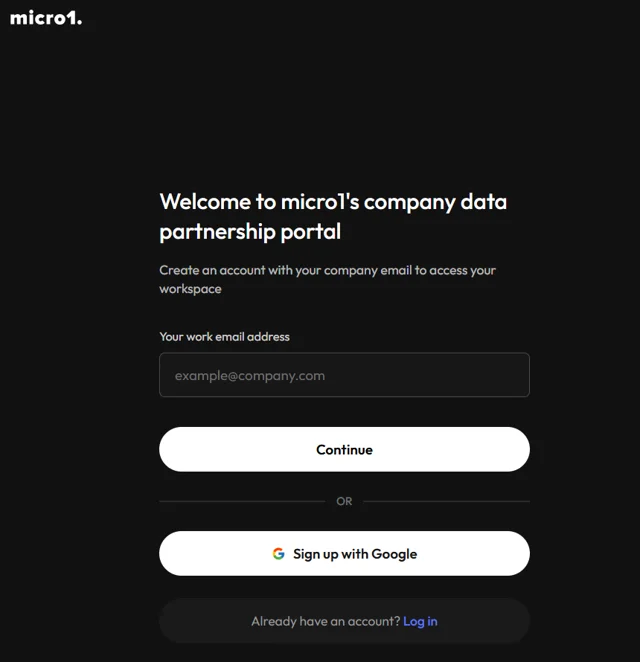 micro1 will ask you to enter your work email to register.
I'm not employed by micro1. If a company signs up through my introduction, micro1 may pay me a referral fee. It costs you nothing and doesn't change your terms.
More guides
- Why AI companies pay for business dataWhat they're buying, and why everyday work is valuable
- Is it a scam?The evidence the program is real, and six warning signs
- micro1 reviewWhat micro1 offers, and the concerns to weigh
- What is your data worth?Published figures and what sets the price
- How names are protectedDe-identification explained, and what to ask before you sign
- If your company has closedWho qualifies, and who can still sign
- Closing your company?Deal with its data before you strike off or dissolve
- An intangible assetValuing or selling a business that holds years of records
- HMRC Time to PayHow it works, and where data licensing fits

About the author
Sean Key has been a freelance consultant for 22 years, mainly delivering data and digital projects into the NHS. He runs Applied Clinical Judgement, which connects professionals with AI training work, and helps established companies weigh up micro1's Company Data Partnerships program.
He isn't a lawyer and isn't employed by micro1. If your company signs up through his introduction, micro1 may pay him a referral fee at no cost to you.
Sean Key on LinkedIn (opens in a new tab) · Book a call (opens in a new tab)